
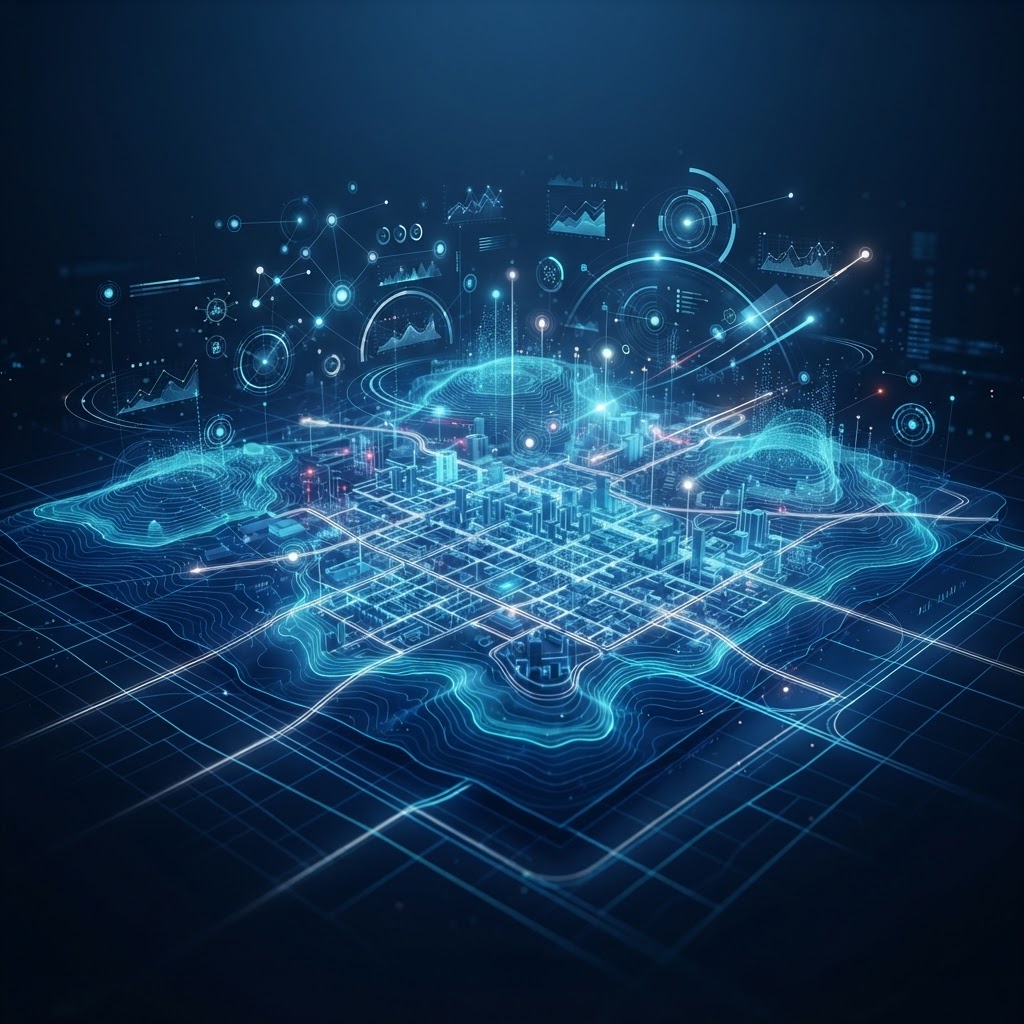
3D Mapping & Digital Environments
Representing complex environments as maintained digital models.
Three-dimensional digital models let organizations represent buildings, terrain, infrastructure, and spatial relationships with depth and accuracy. MCB is developing 3D mapping as a foundational layer for environments where flat maps are insufficient.
The Operational Challenge
Flat maps cannot represent the full complexity of modern environments.
Multi-level buildings, vertical infrastructure, and complex terrain are difficult to communicate through two-dimensional maps. Organizations need a spatial representation that reflects how environments actually work in three dimensions.
- Multi-level and vertical environments are poorly served by flat floor plans.
- Spatial relationships between buildings, infrastructure, and terrain are lost in 2D.
- Digital models, where they exist, are one-time renders that age and go unmaintained.
Functional Description
What this capability does.
MCB is developing 3D mapping and digital environment capabilities to represent complex physical environments as maintained spatial models. The objective is a digital environment that reflects the real one and stays current as it changes, serving wayfinding, operations, and planning.
- 3D model development depends on available source data, including architectural and survey inputs.
- Models are maintained as living representations, not one-time renders.
- 3D layers integrate with the broader MCB mapping and wayfinding infrastructure.
Implementation Status
3D mapping and digital environments is a developing capability. Advanced 3D modeling is not represented as currently operational and is advanced as a planned layer within the MCB infrastructure roadmap.
Industry Applications
Healthcare & Medical Campuses
Higher Education & Schools
Retail & Mixed-Use Developments
Government & Public Sector
Commercial Real Estate & Property Management
Transportation & Mobility
Hospitality & Resorts
Venues, Events & Attractions
Corporate & Industrial Campuses
Destinations & Tourism
Integration Architecture
How this capability fits within MCB infrastructure.
Each capability connects source systems to user-facing experiences through the MCB infrastructure layer, maintaining governance and consistency across every surface.
Source Systems
MCB Infrastructure
The connecting layer
Data normalization, governance, mapping, and distribution across every surface.
User Experiences
Frequently Asked Questions
Next Step